Elie Wiesel and the Art of Storytelling by Rosemary Horowitz
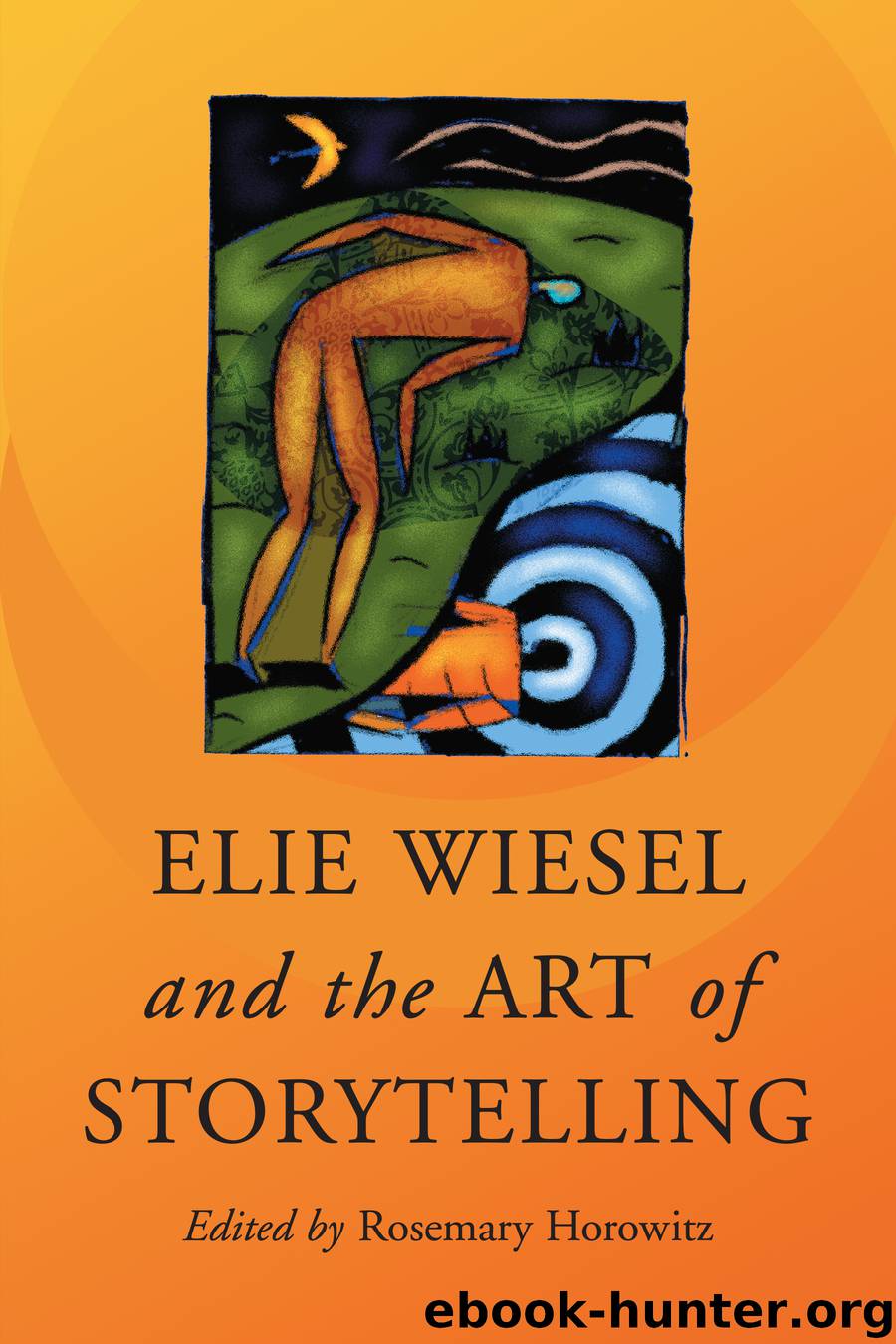
Author:Rosemary Horowitz
Language: eng
Format: epub
Publisher: McFarland
Published: 2017-05-24T16:00:00+00:00
Notes
1. Elie Wiesel, Somewhere a Master: Further Hasidic Portraits and Legends, trans. Marion Wiesel (New York: Summit Books, 1982), 205.
2. Elie Wiesel, Against Silence: The Voice and Vision of Elie Wiesel, Vol. 2, ed. Irving Abrahamson (New York: Holocaust Library, 1985), 60.
3. Elie Wiesel, Against Silence: The Voice and Vision of Elie Wiesel, Vol. 1, ed. Irving Abrahamson (New York: Holocaust Library, 1985), 273.
4. Other scholars have noted Wiesel’s “midrashic manner,” but I do not know of any who have explored the midrashic and aggadic contexts of his writing as I am doing here. See, for example, Sidra DeKoven Ezrahi, By Words Alone: The Holocaust in Literature (Chicago: University of Chicago Press, 1980), 120.
5. Wiesel, Against Silence, Vol. 2, 249.
6. Elie Wiesel, A Beggar in Jerusalem, trans. Lily Edelman and Elie Wiesel (New York: Random House, 1970), 135.
7. Elie Wiesel, Souls on Fire: Portraits and Legends of Hasidic Masters, trans. Marion Wiesel (New York: Vintage, 1973), 187. Elsewhere he writes that, with Rabbi Akiba, “the tale of the law becomes part of the law itself”; see Elie Wiesel, Sages and Dreamers, trans. Marion Wiesel (New York: Summit Books, 1991), 234.
8. Martin Buber, I and Thou, trans. Walter Kaufmann (New York: Charles Scribner’s Sons, 1970), 69.
9. Menachem Mendel Schneerson, Torah Studies, adapted by Jonathan Sacks (London: Lubavitch Foundation, 1986), 74.
10. Emmanuel Levinas, Otherwise than Being or Beyond Essence, trans. Alphonso Lingis (The Hague: Martinus Nijhoff, 1981), 69.
11. Elie Wiesel, Against Silence, Vol. 1, 187.
12. Schneerson, Torah Studies, 74–75.
13. Yitzchak Abohav, Menoras Hamaor: The Light of Contentment, trans. Y. Y. Reinman (Lakewood, N.J.: Torascript, 1982), 246.
14. Martin Buber, Between Man and Man, trans. Ronald Gregor Smith (New York: Macmillan, 1965), 78.
15. Elie Wiesel, A Jew Today, trans. Marion Wiesel (New York: Random House, 1978), 178–79.
16. Elie Wiesel, Night, trans. Stella Rodway (New York: Hill & Wang, 1960), 71.
17. Wiesel, A Jew Today, 81.
18. Cited in Nehemia Polen, The Holy Fire: The Teachings of Rabbi Kalonymus Kalman Shapira (Northvale, N.J.: Jason Aronson, Inc., 1999), 102.
19. Elie Wiesel, The Forgotten, trans. Marion Wiesel (New York: Summit Books, 1992), 11–12.
20. Elie Wiesel, From the Kingdom of Memory: Reminiscences (New York: Summit Books, 1990), 13.
21. See Elie Wiesel, The Golem: The Story of a Legend, trans. Anne Borchardt (New York: Summit Books, 1983).
22. Elie Wiesel, commentary in A Passover Haggadah, ed. Marion Wiesel (New York: Simon and Schuster, 1993), 67.
23. See Elie Wiesel, Evil and Exile, trans. Jon Rothschild (Notre Dame: University of Notre Dame Press, 1990), 155.
24. Elie Wiesel, commentary in A Passover Haggadah, ed. Marion Wiesel (New York: Simon and Schuster, 1993), 32–33.
25. Ibid., 35.
26. Ibid., 34.
27. Wiesel, Against Silence, Vol. 3, 1.
28. As the talmudic sage Rabbi Yochanan taught, “The Holy One, blessed be He, said: ‘I will not enter the heavenly Jerusalem until I can enter the earthly Jerusalem’” (Taanit 5a).
29. Elie Wiesel, The Town Beyond the Wall, trans. Stephen Becker (New York: Holt, Rinehart and Winston, 1964), 10.
30. Ibid., 179.
31. Elie Wiesel, The Gates of the Forest, trans. Frances Frenaye (New York: Holt, Rinehart and Winston, 1966), 33.
Download
This site does not store any files on its server. We only index and link to content provided by other sites. Please contact the content providers to delete copyright contents if any and email us, we'll remove relevant links or contents immediately.
Cecilia; Or, Memoirs of an Heiress — Volume 2 by Fanny Burney(31929)
Cecilia; Or, Memoirs of an Heiress — Volume 3 by Fanny Burney(31916)
Fanny Burney by Claire Harman(26583)
We're Going to Need More Wine by Gabrielle Union(19020)
Plagued by Fire by Paul Hendrickson(17393)
All the Missing Girls by Megan Miranda(15895)
Cat's cradle by Kurt Vonnegut(15307)
Bombshells: Glamour Girls of a Lifetime by Sullivan Steve(14039)
For the Love of Europe by Rick Steves(13826)
Leonardo da Vinci by Walter Isaacson(13292)
4 3 2 1: A Novel by Paul Auster(12354)
The remains of the day by Kazuo Ishiguro(8951)
Adultolescence by Gabbie Hanna(8904)
Note to Self by Connor Franta(7657)
Diary of a Player by Brad Paisley(7539)
Giovanni's Room by James Baldwin(7302)
What Does This Button Do? by Bruce Dickinson(6187)
Ego Is the Enemy by Ryan Holiday(5392)
Born a Crime by Trevor Noah(5359)
